Monday, July 16, 2018

Closing Ceremony Celebration

It's hard to believe that it was almost 4 1/2 years ago when J sent out a seemingly innocent email asking friends if they'd want to try out all the Olympic sports with her.  Six of us started and four of us finished.  We didn't really know each other when it all kicked off on a cool February afternoon, playing "ping pong" in a church rec room.  A few weeks later, we were throwing each other to the ground in judo.  That's definitely one way to get to know someone!


We decided to really get into it and started reaching out to more experts in our area.  What was most amazing to me was that we were able to do every one of these events pretty close to our own back yard in the Dallas-Fort Worth area.  I mean, we have an Olympic sized velodrome less than an hour away!  We met some amazingly giving, patient and talented coaches and experts whom we never would have been able to complete this adventure without.


With new found respect and admiration for the athletes, a few of us traveled over 5000 miles to take in the Olympics in Rio de Janeiro, Brazil!


We had some minor injuries to overcome - a reminder that, although we are awesome middle-aged women who can accomplish anything, we still had to take care to know our limitations.  We also had some fears to overcome - from one who managed to jump off that 5m platform, despite her fear of heights, to another whose stomach turns at the thought of distance running, to all of us seeing those 45 degree banked turns at the velodrome.  We supported each other.  We encouraged each other.  We didn't let anyone give up!


It was great to learn so many new sports and push ourselves to do every single one of them.  Although we had some folks think we wouldn't physically be able to do something (or tell us we were just plain crazy), we did it.  Best of all?  We became friends.


The day after our last event, we met for a Greek lunch.  As a memento of our journey, we each will now proudly display a replica gold medal from the 2016 Rio games.
The Fort Worth do the Olympics adventure is complete!
To those that have followed us on this journey...  Thank you!  We hope you enjoyed reading about our adventure as much as we enjoyed doing it.


Heptathlon - 7/13/18

It's looking more and more like our one sailing lesson will be it, so we decided to go ahead and hold our grand finale event - the heptathlon!


As the name implies, this event consists of 7 track and field disciplines:  100m hurdles, high jump, shot put, 200m, long jump, javelin and 800m.  Traditionally, the first 4 events are held on one day, with the final 3 held the next.  Starting in the 1960's, women in the Olympics competed in the pentathlon, but in 1984, the javelin and 800m were added to become the heptathlon.  There is a scoring system that uses different equations and factors for each event.  As engineers, we had to take advantage of the math!  In order to make it work for us, we created another factor for each event, to get us as close as possible to real scoring.  That way we could get a feel for our overall ability at this event.  We had a simple grid to keep track of our raw scores.


We had previously done all of these disciplines on their own, so we had some knowledge about each.  We met at a local middle school track to set up our version of this test of skills.  Again, we took some creative liberty to make sure we competed safely and to our ability.  First up was the hurdles - homemade, short versions.  We took turns running, with one person timing us at the end.
RA has pretty good hurdling form!
Next was the high jump.  This was the only thing we couldn't do on-site, so we swapped it out with a standing vertical jump - using J's daughter's finger paints!  We first marked our static reach, then made our 3 jumps and measured the difference between the static and highest jump point.
J's impressive jump
Final vertical jump marks
For shot put, L1 had purchased one online and we headed to the sand pit used for the long jump.  This made for easy marking and didn't damage any grass.
J's first shot put attempt
Then we ran our 200m "sprint", followed by the long jump.  We were glad to have a sand pit and stuck with our initial method of jumping from the edge of the pit instead of off the board usually used (not sure I would have made it to the sand otherwise!).
L1 always has the best jumping shots
After our long jump, it was javelin.  L2 crafted a homemade version, as close to spec as possible using a dowel rod, metal spike and cording.
L2's first throw
Finally, we ran two laps of the track for the 800m.

We used quite a bit of gear for this one!
Our crafty heptathlon
It was a tiring day, but a bit surreal when we finished and realized we were done.  Done with our final event!
Event #111 complete!

Cross Country Mountain Bike - 6/15/18

We are getting down to our last few events!  L1 has been cleared for activity after having her baby and we had to wait out some spring weather, but we are now determined to wrap up this adventure!  While we continue to try and schedule our last sailing events, we decided to get out and finally do our Cross Country Mountain Bike event.  We've had this scheduled several times before and it kept getting rained out.  So on a hot Friday morning, we headed out to Lake Mineral Wells State Park where they have a great back country hiking/biking/riding trail. 


CCMB is generally run on a combination of track surfaces - from dirt to pavement - of varying widths - from narrow "single-track" to wider "double-track".  For Olympic CCMB, riders complete laps around a shorter track.  In Rio, the women rode 6 laps around a 4.85km course (totaling around 18 miles).  A couple of us had ridden off road before, but the other two had not, so reading that this location was "good for beginners" had us feeling confident.  It consists of 4 wide (double-track) loops that can be combined together into one larger one.  Initially, the plan had been to do a few laps around the first loop, but...  Well, plans change.


Once we geared up, we rode off along the trail, water and emergency supplies in tow.  Nice large gravel.  Easy!
J and L1 start the ride
Then we quickly found one thing that makes riding bikes very, very hard.  Or should I say soft?  SAND.  We had to ride off to the side or in the grass - and even walk at times.  Then we hit some pretty hefty rocks which we rode over when we felt it was safe to do so, but ended up walking again. 
Taking the safe way down
By the time we hit the decision to continue the first loop or move on the second, we were debating.  We chose to take the risk and start the second loop.  Luckily, the terrain became better.  More packed dirt or grass.  We also rode the third loop, but decided against the fourth, which was listed as the "most difficult".
L2 glad to be on dirt
We enjoyed some nice scenery and even though it was hot and sunny, there was enough tree cover to keep us mostly shaded.  By the time we got back to finishing the end of that first loop (back to the sand), a couple of us managed to power through, but walking was needed again - at least for me.


In total, the ride was just over 5 miles, in around 80 minutes.  Definitely a work out and it became quite obvious why they call CCMB "technical".  Just riding on such ground is hard work, but racing on it???


Event #108 complete!

Wednesday, January 3, 2018

Congratulations!

You may have noticed a prolonged absence from us once again, but it's been for good reason...  L1 has welcomed her first child into the world!  Congrats to L1 and her hubby - you'll be great parents!


Meantime, we'll get back to our quest once L1 is cleared for activity.  We're hoping to wrap up sailing, then finish off our adventure with our cross country mountain biking and heptathlon this spring.  Stay tuned!!!

Monday, July 31, 2017

Sailing #1 - 7/28/17

Sailing!  This has been the single most difficult event to schedule.  Although there are a number of sailing clubs in the Dallas-Fort Worth area, we’ve had a hard time finding one that can fit us into their schedule, on our budget.  That match finally came up with Corinthian Sailing Club and youth coach Greta was happy to take on our challenge.

Olympic sailing has been around since 1896 and the types of craft used for the events has varied.  There have been 46 different classes used to date!  In the 2016 Rio games, there were four sailing events for the women, including the RS:X windsurfing that we’ve already completed.  The other three events are all in the “dinghy” class, which means small boats being sailed using five types of control: sails, foils (daggerboard, centerboard and rudder), trim (angle of the boat in the water), balance (controlled by weight of the crew) and route (factoring in wind, obstacles, tide, etc).  The boats are also all “monohull” design – one chassis, so to speak, as opposed to the catamaran style of the America’s Cup racing boats.  The events are the 470, the 49erFX and the Laser Radial. 

Our first meeting was mostly an introductory lesson to sailing.  We first sat down and went over terminology:  mast, boom, sail, jib, hull, centerboard, rudder, tiller, head, foot, luff, leech, roach, block, clew, tack, jibe, windward, leeward, reach, run…  I could go on and on.  We were on overload by the end of our lesson!  It was interesting to see how much education is required.  Even finding out how many parts there are on a sail was fascinating to me.
  
Learning the parts of the boat
Next, we headed over to take a look at a couple of the boats that we’d be using in future lessons so that Greta could point out the differences. 

Figuring out what lines move what parts of the sail
At the end of the lesson, we headed out on the water.  Greta chose to take us out on a Flying Scot – a larger boat all five of us could comfortably fit in to get a feel for the water and start taking turns manning the helm.  
The Flying Scot
While one person steered the boat, two of us manned the smaller jib sail, each pulling it and locking it into place on the correct side of the boat.  With the nice light wind we had on the lake, it was a nice trip close-hauling (sailing at an angle, into the wind) up the lake.  We quickly discovered that the “telltales” are the key to steering.  On each side of the main sail and jib, there are small streamers attached.  On the port side of the boat, the streamers are red.  On the starboard side, they are green.  The two colors are mounted at the same location, one slightly below the other, so that you can see both.  They should be flowing straight aft, if the boat is sailing properly.  If one, or both, are flopping around, it tells you how to trim the sail.  Small corrections to the tiller result in that smooth stream of air flowing over the sail.  There is also a “no-go” area like we had in windsurfing – where you allow the sail to line up perpendicular to the wind.  Although it’s noisy as the sail flaps in the breeze, it stops the boat quite quickly since no wind is being caught in the sail.

RA glances at the telltales while at the helm
Greta even showed us some of the more extreme ways to move weight about the craft, including leaning out over the edge of the boat, using foot straps to counterbalance.  This was a bit disconcerting for me – I didn’t like being on the lower side of the boat, my upper body immediately sitting forward as I felt like I would get dumped right out of the boat!

J holding a jib line - Coach was willing to lean a bit further out
What surprised me was when we turned to head back to the dock.  Greta mentioned that you can only sail as fast as the wind is blowing.  I figured we’d turn the sail, catch as much wind as possible and zoom back.  Instead, we leisurely floated back to the dock with the wind and current carrying us back, giving us time to ask more questions.


This was a fun first lesson.  Next time, we’ll start out on the Flying Scot once more, then move on to one of the Olympic style boats!

Monday, March 13, 2017

Steeplechase - 3/12/17


As an added bonus of working with Coach Buzz from Texas Express, after we were done with our high jump lesson, we were delighted to get the chance to try the steeplechase.  The most difficult part of that event has simply been locating a track with the right set-up.  Most high schools do not run the event and the college coaches I have contacted weren’t too motivated to help us out.  When Coach Buzz heard we still needed to complete that event, he offered us a chance.


The steeplechase is a 3000 meter (7 ½ lap) event and has been part of the men’s Olympic program since 1920.  It was added in 2008 for the women.  It gets its name from the similar horse racing event and originated in Ireland.  Horses and riders would race from town to town, using church steeples as guides since they could be seen from far away.  During the race, the horse would likely have had low stone walls and streams to jump over.  In the human version, the 3000m race consists of 28 barriers and 7 water jumps, which equates to 4 barriers and 1 water jump per lap.


The barriers are quite different than traditional hurdles.  First they are quite long so that multiple jumpers can go over them at once.  They cover approximately the first 3 lanes on the track.  They are also square – around 4”x4” – and covered by the same type of rubber material that most tracks are made of.  This shape and material aids in the jumps, as many racers step up onto the barrier, in stride, then jump off.  The women’s barriers stand 30” high.

 
Steeplechase barrier


The final barrier includes the water jump.  Immediately behind the barrier is a pit full of water.  Nearest the barrier, it is approximately 28” deep (we had no clue it was that deep!).  It is 12 feet long and at that farthest point from the barrier, is at track height.  The further out an athlete can jump from the barrier, the less water she’ll be landing in.  We saw some preliminary rounds of this event in Rio and there were a number of approaches by the women.  Some did jump the regular barriers completely.  Most chose to step on the water barrier to clear as much of the water as possible.  Others however, almost hopped over the barrier, landing in the deepest part of the water.


A few of us decided to run a lap, a couple of us decided to go ahead and give the water barrier a go.  Since it’s such a long drop, we opted to essentially sit on the barrier and jump from there.  Surely the shoes the athletes wear for this are highly specialized, as running with soggy tennies wasn’t easy!


J and R approach the water barrier

J setting up for her jump
Into the water
And continues her lap
We were happy to get the chance to learn a bit more about this event and have a chance to splash down in the water barrier.  Event #106 complete – only 5 more to go!!! 

High Jump - 3/12/17


We returned to Lovejoy High School to work with Coach Buzz Andrews of Texas Express Track Club on high jump.  There were some similarities to last week’s pole vault lesson, but definite differences as well.


After a warm-up jog and some stretches, we talked a bit about the approach to high jumping.  When the high jump was first competed, there were no cushy foam mats, usually sand, so the jumpers mainly landed on their feet.  As the sport progressed, and mats were added, jumpers moved more to a “roll” style jump where they faced the bar and rotated the length of their body parallel to it.  In 1968, Dick Fosbury won a gold medal at the Mexico City Olympic games and brought his style, what became known as the “Fosbury Flop” into the spotlight.  To this day, nearly all jumpers use this technique that has them bending backwards over the bar.


The general concept is a sprint run-up, straight toward the bar, but off to one side.  The final few steps are then taken in a curve, becoming parallel with the bar.  The shape that is defined by this run is a “J”.  As the jumper approaches the bar and begins the turn, the body will lean away from the bar, due to centripetal force pulling the body inward toward the center of the circle shape they are running.  When the jumper lifts the knee and arms to begin their jump, the force is released and the body can then bend and get over the bar.


We started off like last week by running the “J” backwards, from the mat.  That defined our starting marks.  Then we did a few runs without jumping, to ensure our bodies were leaning away properly.

J shows the proper lean away from the bar
Then we did some initial jumps onto the mat with no bar.  A couple of us really struggled with either trying to jump off of the wrong foot, or trying to hop off of both feet.  In order to complete a successful jump, you must jump off of one foot and the bar must remain on the stand (touching it is okay, as long as it doesn’t fall).  Personally, my body just didn’t want to make the backward bend – I looked more like a doll with no bendable limbs falling back into the mat!  As some of us got the feel for it, we worked over the bungee “bar” to a height of around 3-4 feet.  The other two of us did really get the hang of a more sideways motion over the bungee and even managed to fully clear it once or twice.

 
R shows great form at takeoff with arms up and knee high

L1 cleared the highest bar
Even with our mixed success, we were all glad we had the opportunity to try this event, especially with the assistance of a great coach.  Thanks again, Buzz!  High Jump (event #105) complete!


Tuesday, March 7, 2017

Pole Vault - 3/5/17

We're BACK!  After a much needed break and time for one of our Olympians to heal from a nagging foot issue, we are ready to finish off this journey.  Only 8 events left to conquer!!!


We spent a rainy Sunday morning at a beautiful indoor facility with two great coaches for our pole vaulting lesson.  Buzz Andrews and his son, Chad – of TexasExpress Track Club – are elite level coaches.  They have worked with many youth and adult athletes over the years, so we’re lucky to have convinced them to give us a shot.


We started out with a good warm up jog and stretch, then went right into the proper way to grip a pole.  First, we held the 11 foot pole next to us and reached up as high as we could, standing on our tip-toes.  That located our dominate hand placement.  Then, gripping with that hand, we bent our elbows tightly.  Our non-dominate hand would be placed two finger-widths from where the tip of our elbow landed. 

Coach Chad explaining hand positioning
Then we talked about the proper form for holding the pole when running.  The top, dominate hand, should be down by the hip, palm open and facing forward, loosely supporting the pole.  The lower, non-dominate hand should be up, holding the pole somewhat loosely again, with the tip pointing across the body.  A relaxed, almost bouncy gait is used when starting run up to the vault.  We practiced running on the turf slowly at first, then faster.  Then we worked on footing and planted the pole to do tiny swings, taking off and landing on the same foot.  All the while, we were reminded that we should always hold on to the pole – neither hand should ever come off.  (Reminded us of rowing – “never let go of the oar!”)  Next, we went over to a crash pad where the coaches measured our steps away from the pad to mark the turf with our individual starting points.  We would be doing a “3 step” approach – which is actually 6 steps (they only count the left foot strikes).  We started with the same small swings, landing on our feet, but on the crash pad.  Then we went on to swinging our legs up and landing on our rear ends.  This was really the first hesitation point, but L2 went first and convinced everyone if she could do it, so could they. 

L2's first "rear" landing
Once we cleared that ~12” pad, we added another.  Then the coaches eventually added a bungee another foot or so above that.  Due to the padding around the real vault box (the metal, in-ground location where the tip of the pole would be set for going over a real bar) being even higher than that, the coaches decided it wouldn’t be safe for us to try actually using that area.  But clearing around 36” was good enough for us!  We all managed to get over that height at least once.  R was the best at getting her feet up in the air – and actually bent the pole!

Coach Buzz and Coach Chad hold the bungee while R attempts a vault
L1 probably had the most impressive form jump of the day, but it was J who dominated.  The coaches were even trying to convince her to continue with lessons to possibly get into Master’s (or “old people”) level competition.  She was determined to go higher and higher – actually jumping the highest of all of us, requiring a slightly longer run up and higher grip.

J concentrates on clearing the bungee
Overall, we were all impressed that we actually managed to complete this event.  No one actually jumped in the usual upside down form, but clearing three feet or so was definitely a WIN!


We’ll be back with the same coaches next week for another event, or possibly two…  Pole vault COMPLETE!!!

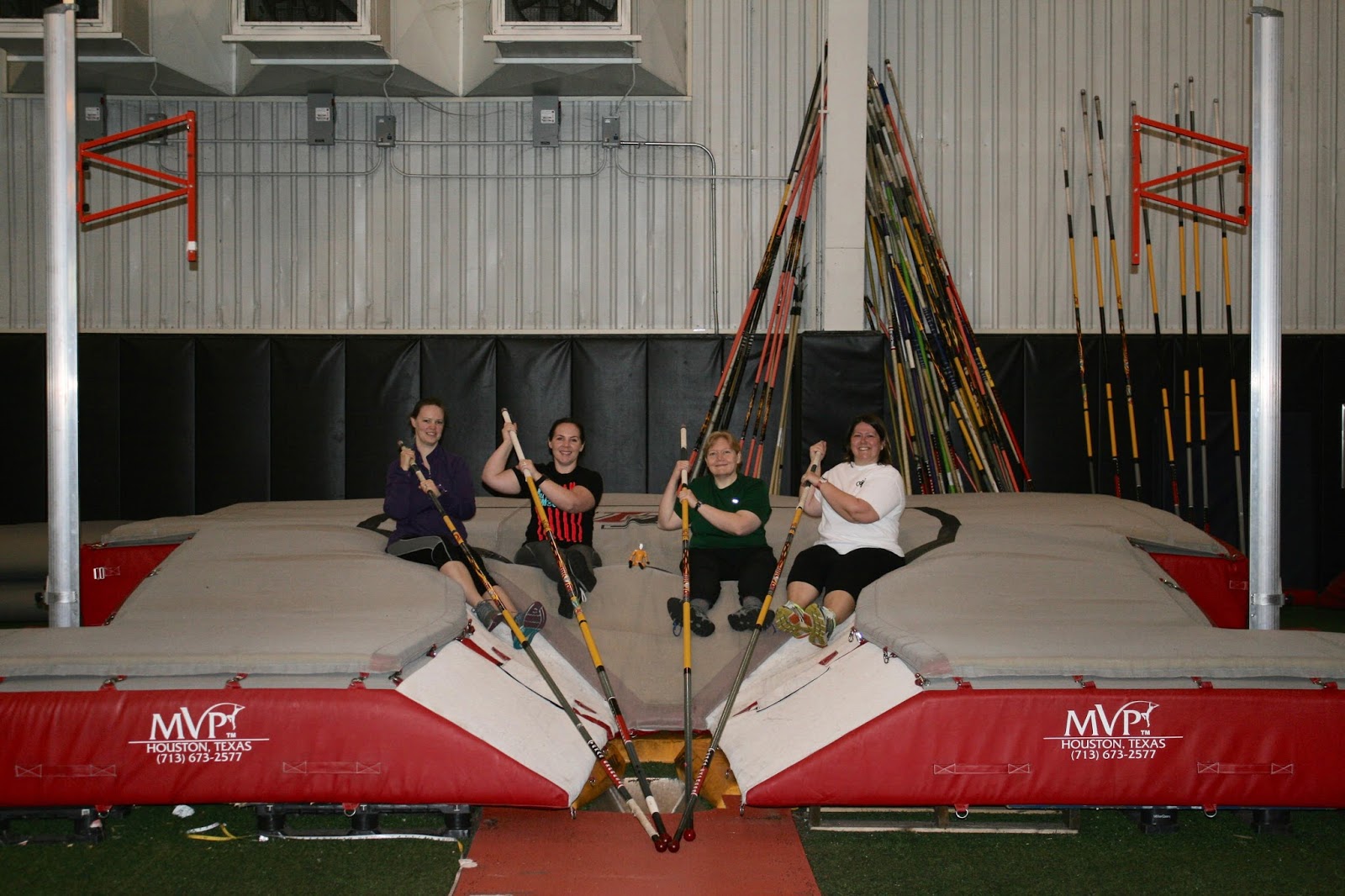
Though we didn't use the real vault box, it makes for an impressive photo

Thursday, October 20, 2016

Another Break...

Just a quick update for those who may be anxiously following our journey that is nearing its conclusion.


One of our ladies is having foot surgery soon and won't be able to participate in any of the activities we have left for 12 weeks.  Rather than leave her out as we finish, we've decided to take a break, get through the holidays and work on finishing strong in the spring!


Thank you for your support and we'll be back at it again in 2017!!!

Tuesday, September 27, 2016

Rio de Janeiro - the XXXI Olympiad

I would be remiss to not include another great adventure that three of us recently took...  A trip to Rio de Janeiro to see the REAL athletes do these sports justice.  When we started on this adventure, we jokingly said that we'd need to cap this whole thing off by going to Rio.  As time went on, we discussed it further, signed up for information, then decided to go for it!  Although we haven't quite finished all of our events, it was well worth the long flight to appreciate everything that the Olympics is, in person.


Over the 8 day trip, we attended 13 different events:  handball, judo, basketball, fencing, rowing, track & field, weightlifting, boxing, trampoline, badminton, table tennis, wrestling and synchronized swimming.  We focused on some of the "less popular" sports that we have each enjoyed during our journey.  We met great people from around the world, tried plenty of Brazilian food, and walked until we couldn't walk any more.  What a fantastic trip that made us appreciate the dedication and effort that these athletes put in every day of their lives for that one chance to represent their country and try to win gold!  A few of us are strongly considering a trip to Tokyo in 2020...


Now for just a few photos!


Our first evening at Olympic Park - one flag from every nation, with the Carioca Arenas in the background


The Olympic cauldron, standing in front of the Catedral Candelaria


Our first medal ceremony was following the women's team epee finals


We even got to see Usain Bolt run in the 100m preliminaries!

Monday, September 26, 2016

Sailing (Windsurfing) - 9/23/16

Windsurfing is one of the four sailing events at the Olympic games.  The event was first held for men in 1984, then for women in 1992.  An interesting aspect of windsurfing at the Olympics is that one specific "rig" (board, sail, daggerboard and fin) is selected each year and all competitors must use the same exact equipment.  Generally, the rig is chosen based on its ability to be used in many weather conditions, as the event is held regardless of conditions the day of the competition.


The equipment we used was very similar to what they used this year in Rio, but better for beginners.  (Smaller sails for better control and overall much cheaper!)  Our coach, Dean Peaple of Core Adventure Sports, was very happy to see that the weather cooperated with us when we headed out onto Lake Ray Hubbard for our lesson.  It was sunny, around 90 degrees and winds around 10-15mph.


We first got a quick land lesson to understand the rig and some of the jargon associated with the sport.  We then headed out to the water and Dean showed us the basics of how to get on the board, pull up the sail, then start to ride.  He also went over turning (a tack or a jibe, depending on which direction you turn) and stopping.  As simple as he made it look, we all struggled to keep the rig heading in the right direction!


The first step was to get the rig out into water deep enough to clear the daggerboard (used for stability) and fin underneath.  With our backs to the wind, we'd then climb on and sit on our knees.
L1 climbs onto the board for her first ride
Next, using the uphaul (cord attached to the mast), we pulled ourselves to standing, then continued to reel in the sail until we reached the "neutral position":  sail perpendicular to the board with hands at the very top of the uphaul, just below the boom - the grip that you hold while riding.  This is called neutral position because, with backs still to the wind, the breeze will blow over the sides of the sail, not putting any pressure on the rig and generally keeping you in one place in the water.  It was also the "safe" place to go back to at any point if we wanted to stop or take a break.
R working her hands up the uphaul to raise the sail
Once comfortable, using our lower hand, we'd release the uphaul, reach over the upper hand and grab the front part of the boom.  Then, quickly release the second hand, grab the boom and shift both feet slightly back and rotate the front foot so it faced more forward.  This proved to be quite a lesson in ballet.  Lots of things to remember and movement to make, but to stay balanced, it had to be quick and fluid.


Finally, look the direction we wanted to go - and ride!
J heads out on her first ride
We all had moments where we "got it" and were able to stay up for an extended period.  L1 rode the furthest out, then fell when attempting to turn around.  We all ended up in the water over and over (and got a little more graceful on how we ended up there) but kept getting back up.  The boards are quite stable and it was surprisingly easy to climb back up even when it deeper water.  The hardest part for me was getting a feel for the wind.  When it was consistent, it felt great, but if there was a gust, or a lull, the sail reacted, usually causing us to over-react and end up in the water.
L2 trying (unsuccessfully) to recover when the wind let up
This event was a great chance to try something very different from anything we had done before.  It's easy to see how addictive it would become to really get good, then seek out better equipment and better weather/locations to ride in.


We had a great time and are glad to have our first sailing event checked off the list!


With one of our rigs and coach Dean - RS:X Windsurfing complete!

Tuesday, September 6, 2016

Rowing - 9/3/16

We were finally able to locate a group willing to help us with our final rowing event - the Eight!  The most difficult part about it was simply locating a boat.  Not many clubs have one, partially due to the cost of the boat, but also due to the space required to store it.  The boat is about 60 feet long!  One other group had a boat, but the cost was a bit out of our reach.  Luckily, the TCU Rowing Club was willing to let us use theirs.


The Eight is the largest boat used for competition.  Also unique to this event is the presence of a "coxswain" in the boat - so the boat in fact carries nine people, although only eight row.  From Wikipedia:  "A successful coxswain must keep track of the drill, time, pace, words of the coach, feel of the boat, direction of the boat, and safety. During a race, a coxswain is responsible for steering, calling the moves, and responding to the way the other boats are moving."  The term "coxswain" is derived from terms that essentially mean "boat servant".


It was a gorgeous Saturday morning in late summer when we met Coach Pete, from Fort Worth Rowing Club and TCU Rowing, at Marine Creek Reservoir.  Water has been down on the Trinity River, so rowing of the eight needed to be somewhere with a sufficient water level.  We signed our waivers and reviewed the correct positioning and motion on an erg with one of the TCU rowers, then headed over to the boat to take her down to the water.
Getting ready to put the boat in the water
Coach Pete was our cox and had two experienced rowers on either end of the boat, with the four of us in the middle.  The eight is a sweep boat - so each person has only one oar.  We first started with only a couple of people rowing at a time, then worked on some basic drills to ensure the boat stayed level and steady and that our timing was correct.  Slowly we added more rowers, two at a time, until we were up to all eight.  We practiced an "Olympic start" which means we start off by taking two half-strokes, followed by a 3/4 stroke before going to full strokes.  This gets the boat moving quicker and keeps it steady, as opposed to full out strokes from the get-go.


Much like we saw with the four-man boat, it was amazing at how simple it was to row once we all were helping.  It almost seemed like it took no effort.  When it comes to racing, it all comes down to timing to make sure that every person is moving as much water as possible, at the same time.  There were a couple of kayakers also in the lake and we left them behind quite quickly each time we'd get moving!


Almost 2 years since we first rowed, we have now finished.  We've all very much enjoyed the sport and have been very lucky to have found such great people to help us learn the basics!  A huge thank you to everyone that has taken the time to teach us!!!
Our crew!

Monday, August 1, 2016

Rowing - 7/29 & 7/31/16

Back in October of 2014, we did our very first rowing  events.  We all did our solo sculls and a couple of us were able to do the quad sculls.  We were able to add to those events this past weekend out at Dallas Rowing Club.


The DRC does formal "Learn to Row" classes and were willing to work with us on a couple of days to complete these events, deviating from their usual introduction.  The result was a couple of great mornings on the water getting to know a few of the club's rowers and trying out new equipment!


We started out early on Friday morning with two of us in a "quad-plus" boat.  The weather was great and the lake was calm.  This boat was set up to do "sweeping" (where each rower has only one oar).  This is not an Olympic event, but since none of us had ever done that sort of rowing, it was a good way to be in a more stable boat with assistance of two seasoned rowers.


L1 and L2 in the quad-plus with R and J in their doubles
While two of us were out in the quad-plus, the other two went out to do work on double sculls (sculling is where each rower has two oars).  Again, we were with a knowledgeable rower to help us get the hang of it.  We had previously been told that the doubles and pairs boats are by far the most apt to tip, so it would be very hard for novices to jump right in.  I'm happy to say that not one of us ended up in the water throughout the weekend!


J is all smiles in the double
On Sunday, we all had a chance to row the quadruple sculls.  We had more wind and the water was choppy, so it made for some interesting learning moments.  J and L1 had done this previously, but were happy to go back out again.  R and L2 had their first chance to try the larger boat and did very well!  A few of us "caught a crab" a time or two - meaning our oars got pulled under the water some.  We all remembered rule #1 - DON'T LET GO!


R and L2 rowing the quad sculls
Also on Sunday, one very brave soul at the club was willing to go out with each of us, one at a time, on the pair.  This is definitely the least stable boat of the bunch - very narrow and each rower only has one oar, meaning you must work very closely together to keep the boat level.  With the higher winds, we carefully picked a route that kept us closer to the dock.  A very special thank you to Bob for being so fearless and patient!


L2 heading out in the pair (sweep)
It was a great couple of days working with a number of fantastic people at the DRC.  Laura, Gina, Mel, Bob #1, Marianne, Kim and Bob #2 - thank you for being brave enough to take us all out!!!


With all of our new friends at the DRC!

Monday, July 25, 2016

Water Polo - 7/24/16

Water polo has been part of every Olympics except the very first.  Although the men started in 1900, the women didn't get their chance until 100 years later!  European and Russian teams dominate the men's international play, while the US and Australian women have been the only ones to win multiple Olympic medals.


The sport is one of endurance more than speed or agility, though there are some players whose fast swimming skills are put to good use.  The game consists of 4 quarters, 7 minutes each.  An athlete can swim up to around 16 MILES in one game!  It is an incredibly physical game with constant battles for position.


We were lucky enough to have George Fenton of the Dallas Water Polo Club welcome us to one of their practices.  We first started in the shallow end of the pool to get some basic info on the rules and start working on passing techniques.  Teams play with one goaltender plus 6 swimmers.  In general, you can never have two hands on the ball, instead "flicking" or passing from hand to hand.  "Dribbling" is accomplished by touching the ball with the inside of your arms as you swim down the pool.  A quick shot might be made by then flicking the ball out of the water, only by about 2", then slapping the ball for a shot.  Or even a quick partial dunk of the ball to buoy it out of the water, a quick grab and back swing, then full on shot.  Defense is constant, both on the ball and off the ball.  In fact, a LOT of contact is allowed away from the ball, with less allowed where the ball actually is.  Dunking, pushing, nudging, pulling is all pretty much legal - possibly because it would be too difficult for the referees to police.  (We went to a USA Women's tournament earlier this year in our area and one woman even had to leave the game to change suits because hers got torn.)


We then moved to the deep end of the pool to work on our treading water (same motion as we used in synchronized swimming!) and on getting lift out of the water for passes and shots.


In the deep end!


We quickly found that it took a lot of energy and concentration just to try basic skills while staying afloat - much less above the water for shots and passes!
Next we moved in front of goal to take turns taking shots.  We also each took a turn playing goaltender, which was quite exhausting.  The timing for when to try and launch yourself either upwards or sideways was very difficult to gauge.


L2 takes a shot on goal


We finally moved back to the shallow end and asked some more questions about the sport.  Then we took some time to watch the experienced players play their pick-up game.  There are so many little details with this game that would be hard to master even on dry land - kind of like putting soccer, basketball and handball together - it has to take so much longer to get in the water!
One last note as we donned some caps for our group photo...  George mentioned the caps were introduced not for the "player number" aspect, but really for safety.  Competition can get brutal and some players were known for popping ear drums of their opponents from behind!  The caps have build in plastic covers to protect ears from such blows.


Water polo complete!